Showing posts with label aids. Show all posts

Wednesday, February 17, 2016

Start At The Beginning –The Lesson of Literal Enlightenment

One of the most exciting things about moving to our new paddocks, and this is what I’ve most been looking forwards to (besides the giant indoor arena) is the fact that there are great instructors that come in to teach at the facilities on a regular basis.

A month ago, we had our first lesson with a classical dressage trainer, and ohmygoodnessitwasthebesteverandnowIamsoexcitedit’scrazy!!

*deep breath*

IMG_7503- Waiting around for our lesson to start, we were both suffering from extreme attacks of the needle… He’s spooky and I just feel plain old sick… But as it turns out, we needn’t have worried!  -

I should try not to get ahead of myself, but it really was such a good lesson…. As I remarked to MG (Mighty Guy – Classical Dressage Instructor Extraordinaire!) after the lesson, it was difference between groping around in the dark at a book, unable to read it because it is closed shut and you can’t see. You are struggling to take the next step towards that elusive feeling, and then someone just - *ping!* - turns on the light, opens the book right in front of your eyes, and explains exactly what it means, in great detail - right then and there to you.

It. Was. The. Best. Ever.

We learnt a ton, but we didn’t do much: Halt, flex, walk, counter shoulder in. That was it. Only walking for the whole hour, and I couldn’t keep the grin off my face!

Right from the start, I was told quite simply that Copper doesn’t know any of the basic building blocks of carrying a rider – how to give to the aids. I didn’t know how to teach him that, and we’d never been taught any better. Copper showed how little he knew by marching around with his “race track” walk, which is super fast and not at all a clear, four beat pace, just a churning of the legs!

He needed to slow down and learn to give… And we so were taught how to do that.

What did we learn?

  • Copper needs to learn to give to the aids, not react to the aids. He is not soft, and that’s why he is always so twitchy and fast.
  • He doesn’t know how to give to the rein aid/and my hand. He holds his tension in his jaw, poll, neck and shoulders. (Haha, tell me something I don’t know!  : P )
  • We were taught four flexion exercises for releasing the ligaments under the jaw and neck – all are preformed at the halt, and involved lifting his head and asking him to soften, chew and swallow. The fourth one then asked him to soften over his topline and bring his nose down again without locking up.
  • These flexions where done in stages: first one was done at the halt on the ground, then repeated under saddle. Then we had to walk around and halt and ask again for the flexion any time he started to fall downwards towards the forehand, or stiffens his jaw.
  • The second and third are pretty much the same one – flexing to the left and right from the poll
  • The fourth is asking him to round over his topline all the way along his back and neck.
  • We built up through these flexions with a lot of walking around a 20x40 arena space, including changing the rein across the diagonal and asking him to stretch out over his topline. He actually strode out with a clear 1-2-3-4 beat and a nice stretch without falling into his chest! A baby walk-lengthening!! 
  • We did the first exercise on both reins and when he was soft, did two and three, one on the left rein first, then the other on the right.
  • Then we moved to learning counter shoulder-in. Which was totally confusing for a directionally-challenged body such as myself.
    • The counter shoulder-in started with a walk down the long side, a six meter half-volte at the end, in the corner, which brings you back to face the long side you just walked down.

      Then, facing the wall asking for the bend towards the direction you just came from –i.e., back towards the corner – you ask with the inside leg, (which is the one your horse is bending around) for the horse to move in the direction OPPOSITE to your bend; back down the long side.

      You should feel the outside shoulder step into your rein and the inside hind crossing underneath as the horse steps over one foot at a time.

      The slowing down, but lifting at the front, is crucial to this exercise. Where it can go wrong: the horse rushes through it and looses the true bend from nose to tail, or alternatively, the horse dives down and falls into the bend, leaving his tail trailing off every which way.

      When done correctly, you can feel each footstep as the horse moves across, and the shoulders fill both reins.

We were swinging along with the exercise, and then tried a counter-shoulder in along the imaginary fence down the middle of our half of the arena. Yeah, I couldn’t get it AT all… We got hopelessly muddled and I know it was my fault! Even with MG helpfully directing the rein on one side, I still couldn’t get it, so we gave up on that and just worked along the wall.

All too soon the lesson was over, but I was giddy with excitement. I hadn’t stopped grinning like a fool the whole lesson, and I kept giggling, because riding Copper through out this lesson was like riding on a champagne bubble - and just as intoxicating!

He. Felt. Brilliant.

It was the very best I have ever gotten from him, or from any other horse I’ve ever sat on for that matter….

Yes, it was a month ago, but I still remember that pure joy that came from finally understanding how to achieve what I have been chasing these last few years - if not, my entire riding career.

I can NOT wait to do it again….

Even if I did just walk for an hour!

See ya,

bonita

Friday, October 4, 2013

Dissecting the Seat – Part 1: Pulling my seat apart


I will be starting a series on dissecting a rider’s seat as I am trying to reconstruct my own seat using the practice of classical dressage. This post is kind of the beginning of where I start with a muddle as I pull my riding apart! 

I have been busy trying out a few new things with Copper – I don’t really have anything solid yet, but I’ll report anyway.  (^ u ^)

I’ve really been concentrating on figuring out my seat and what affects it has on Copper’s way of moving.  Have you ever sat on an exercise ball and tried to feel what direction the points of your pelvic bones are pointing in?

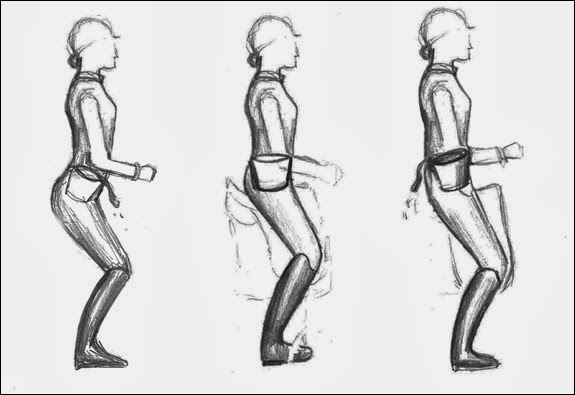
rider seat positions- Left position: rider is hollowing back and disengaging the seat.  This will make her position precarious, and she will just bounce along on top of the horse’s back, rather than influencing it.  It also means she will fall off easier!  I know, because this used to be my seat…  : / 

Middle position: rider is in a good neutral position to have an independent seat, meaning that she can at will influence the horse’s back, hind end and thus, the gaits.  She can encourage a faster pace by swinging her hips more vigorously in time to the horse’s movement, or draw up and ‘brace’ her lower back – blocking the horse’s movement over his back and causing him to slow down.  If posting to the trot, the same effect can be achieved by posting slower than what the horse is trotting.

Right position: rider has tipped her pelvis forwards, and while you do not want to hold this position all the time – i.e. as your neutral, not asking for a forwards movement, position – this is a good example of a driving seat aid.  Once the desired forwards movement has been achieved, the seat should be allowed to swing back in the balanced, even position, or the rider will be sitting too far back to follow the horses movement and will be left behind, as well as put into a chair seat where the lower leg will come forwards off the girth and be rendered less effective. -

Sitting up straight and evenly, your pelvic bones should be horizontal to the ground,  with the points of your seat straight down, vertical to the ground. Tip them forwards, like you are pushing the exercise ball out from under you, and your core should curl forwards and engage, your lower back should round out slightly as your tail tucks under.

As far as I understand from all my reading(!) that’s the seat aid for engaging your horse’s motor – his hind end.  With this aid you ask for forwards; walk, trot, and when you use one side of your seat, or rather, lift one seat bone up and forwards, you can ask for canter with scarcely any effort at all.

Breath in and up; pull your spine up from the top of your head, drop your shoulders and “hold” your breath.  Drop your heels and your weight into the saddle and close your fingers on the reins. 

That’s the aid for halt; if you ‘block’ your horse’s movement with your seat only momentarily, that’s a half halt.

Basic stuff, yet as I am working on applying it to my riding, Copper is rounding up, lifting his back and coming through with uphill movement in a way I have never would expect a Standardbred to be able to manage!

It’s true what they say that correct dressage should improve a horse’s action and way of carrying himself under saddle. 

He’s far from perfect, he does not bend his hocks enough yet, so the suppleness of his hind end is somewhat marred by a lack of suspension.  He is being to understand lateral movements, but unfortunately, he is now a little confused about lateral work and how it relates to circling.  As far as I can tell (and I’m not quite sure, because I’m a little confused about what is happening underneath me!) he is moving away from my inside leg requesting bend and “slipping” out from underneath me sideways!  Now I tried catching him with the outside rein/outside leg, but that just made him go all wobbly and crooked. 

wobbly_line - I feel like this ^ is what our progress around the arena looks like! -

So I definitely have to work on that as he is going really well in straight lines but we seem to have lost all ability to do a 20m circle! He actually does a 15m circle quite nicely.  I wonder if I am applying too much inside leg?  With all the work I have been doing to use my seat aids only, I might be getting too strong when coming back to a movement that seems to require ‘more leg’ than tracking on the outside track.

circles- This would be an improvement on the current state of our circles… - 

I am feeling all discombobulated on his back – I can’t seem to post at the moment(!!), so I am mostly working in sitting trot to feel what he is doing.  His stride is so choppy compared to Joey’s *sniff* that it can be quite hard to do that without some serious breathing out to relax my pelvic floor.  Then he gets all bobbly and wobbly as I’m trying to work out what he is doing and how my seat relates, and just – ugh. 

On the upside, I do know I am on the right track, as one of the ladies down at my yards was commenting on how nicely he was rounding up for me.  Plus, Copper himself is confirming we are on the right track – I have never felt him so uphill in all my years of riding him, so we are getting somewhere.

Then I have been acutely conscious about how my saddle tips me backwards slightly – just enough that I have to struggle to get and keep my leg underneath me, and if I lose my balance, or forget to think about it I end up in a slight chair seat. 

I’ve checked the balance of the saddle on Copper – the gullet shape matched his withers and shoulder shape perfectly, and he always get an exact imprint of the saddle (for the sweat mark) when I take it off after a ride.  His back does not seem sore at all, so I’m a bit puzzled.  My conclusion is that the saddle fits him – it just doesn’t fit me

Wintec 2000

It’s an Wintec 2000 All-Purpose, with CAIR panels, and an interchangeable gullet system. I’m not sure if it actually doesn’t fit me, or it’s giving me the seat that an All-Purpose is supposed to, when I am looking for a dressage seat?

Anyone out there with saddle fitting experience and some advice?

I did lift it at the back a little the other day, and I like the results.  It helped me keep my leg underneath me easier and I didn’t feel like I was tipping backwards so much.  I’m thinking I would like to try a riser under the cantle – just a little one to help my balance a bit.  I just don’t know if that’s what is needed, or whether I’m trying to change the balance of a saddle that is designed to give you a bit of a jumping seat. 

Again – comments would be appreciated!  I’m thinking I might need a new-to-me second hand dressage saddle if the latter is the case.  I do want to jump, so I’d keep the All-Purpose, but a nice dressage saddle might really help me with the work I’m trying to do with my seat.

So that’s the run down on my rides and thoughts about riding for the last little while – I know it’s a bit of a dump, but I do like getting it out….

See ya,

bonita

Thursday, November 15, 2012

Contact – so THAT’S what it feels like!


dressage-contact 
I’ve recently had another aha! moment with my riding – this time it’s all about contact.  I actually am starting to get what it is/feels like now.  It’s only taken me donkeys years of riding to finally understand it; but hey…

Basically, the discovery came when I figured out that I should really be bending my elbows.  Yah, I know – basic stuff, but honestly, if my instructor isn’t telling me to bend my elbows then how am I going to know?

That is, until I do something like take a video of my riding and go “Wow, what straight arms I have!  That’s not good!!”, which is essentially what happened…

And then Joey started to work into the contact and I was like – “Oh, okay - I can actually feel my horse’s mouth… It’s heavy!”  But the thing was I knew it was finally right.  We were getting a give-take connection that was elastic and soft, although it felt weird and ‘heavy’ to me.

You see, I blame it on reading too many pony books when I was growing up, and essentially teaching myself to ride.  They all talked about fantastic riders who “held the reins like strands of silk” or “wonderful light hands” – or in complete contrast “he had beginner’s hammy hands”!   And as a result I got the idea that the lighter and softer – the better.

But that’s not quite the case – I tend to ‘throw’ away contact before/after upwards and downwards transitions so that I don’t “pull” on my horse’s mouth.  That means I’m not providing any support for those transitions either, so my horse pops his head up and asks “Where’d you go?”. 

I also taught Copper to carry his own head which meant that he wasn’t on the bit correctly – he broke at the 4th vertebrae, rather than his poll, tended to be a bit ‘behind’ the bit and didn’t engage fully through his back. 

It still LOOKED pretty, but it wasn’t correct.  We didn’t have any 'throughness’, which is a weird dressage term I tend to understand as being the horse’s flow and energy coming from behind me.  It has to come through unbroken from the rear, across the back, over the neck and down into the bit.  I shouldn’t break it with my seat or hands, and if my horse isn’t fully engaged then we won’t get it either. 

So I have learned that if the horse can’t feel the rider’s hands and receive connection with them, then even though the rider’s seat might be connected effectively, the connection for the front part of the horse (shoulder, neck, head) to communicate with it’s rider is still going to be missing.   Rider’s core, seat & legs = horse’s back, quarters, hind legs.  Rider’s shoulders, arms, wrists/hands = horse’s shoulder, neck and head. 

If the rider provides a steady contact, and an effective seat aid that drives the horse forwards from behind, then the horse will naturally offer to round up and come on the bit by itself.  It sounds simple, and it sort of is, but sometimes it still takes a lot of work to get it right!

I’ll keep at it though, and practice a ton of transitions to help.

See ya,

bonita

Thursday, August 23, 2012

Figuring it out - Canter Transitions


1333862257273_160336

Things have been a bit slow at the moment; but I have been busy at the riding school, teaching the Tiny Tots class and in return…  Riding lessons!

It’s so nice to ride a horse that isn’t going to fuss, or freak out unexpectedly - I am really enjoying it as a wee bit of a break from my never-quite-know-what-you-are-going-to-get Joey lad! 

Also, I get to practise cantering!!  Haha.  I know, I know – I sound like a total n00b saying that, but it’s true.  When I had Copper I had to go back and teach him the basics of using his body and balancing himself with a rider on his back.  While he liked to canter, it wasn’t pretty, nor particularly safe as he’d race around like he was a motorbike on a racetrack, leaning over on a really sharp angle.  I’d have to lift up my seat and plant my butt over on the outside of the saddle to counter-balance his weight so that we didn’t go over sideways!

Needless to say, I stuck with walk and trot work before moving up to cantering.  The only problem is that we were only just getting to that stage when I discovered that I had outgrown him, so then of course I leased him out.

Whereupon I replaced him with Joey.  Hmm, young, green, unbalanced horse?  Huh.  Guess we’re back at the walk and trot….  *sadface*   Not that I mind all that much, but it does mean that I haven’t done any serious canter work in years. 

And as a result I found out that my canter transitions suck when I got a horse that knew the job and I couldn’t get a canter out of him.  : /  
I fixed that by changing the rein, for some reason I find the right rein canter easier than the left, then when I switched back I got the left rein canter lead.  However, I was still not satisfied with that solution.  

I had noticed that when first asking for the canter transition I was dropping my left shoulder down and I knew that was the problem, but I didn’t know why.   So back home I did some research and felt like a detective when I figured it out!

I was actually tipping my shoulders forwards in an effort to produce canter, however, in doing that, I weakened my driving seat aid.  To compensate I dropped my weight down on the inside to try and strengthen the inside leg aid.  Of course this resulted in my dropping the left shoulder, blocking the horse’s inside shoulder which he needs to be able to LIFT in order to strike off with canter!   Also, in tipping forwards, my weak seat would have allowed him to string out in the back so he probably couldn’t get his hind end under him to lift his shoulders up either.   *whew* 

While all of this was happening, my instructor couldn’t actually see my shoulders tipping forwards, but I am hoping that the solution for me will to be “sit back”, keep my shoulders upright/slightly back, and drive with my seat. 

We’ll see if this turns out to be the cure for my crappy canter transitions, but I know for sure what I am doing wrong so at least we have half the diagnosis!

See ya,

bonita

Post share buttons