Sunday, June 22, 2014

Dissecting the Seat – Part 3: The Advanced Independent Seat

I found this article thanks to Austen from Guinness on Tap and absolutely had to share it.

It showed what I have been working on when riding Copper. I have been working on being mindful of my balance, engaging my core, lowering my center of gravity and rolling my shoulders back and down to correct my postural tilt.

These things I have been feeling but have been unable to express in a concrete, definite way about how this was affecting my seat and engagement with Copper. When I read this article, it was brilliant – clarifying and just like – oh! So that’s what I’ve been feeling!

It’s such a good article, I really feel it’s a must for any rider who is seeking to find that ultimate connection and engagement with their seat when they ride. It’s so good that I wanted to share all of the article because I hope it never disappears. This is one I’ll be coming back to and re-reading for sure. So here it is, and if you enjoy it as much as I did, please go check out Horse Collaborative for more excellent articles.

Sitting On A Horse In Balance

Gabrielle and Camille Dareau
© www.happy-horse-training.com

The challenge of sitting on a horse in balance may appear no more complex than any other form of balancing – just a case of getting your bearings and learning to go with the horse. In fact, there is a lot more to it than that, because on a horse, our natural balancing reflexes do not lead us to sit in a way which will eventually allow a profound gymnastic connection with the horse – a way which is also comfortable for both horse and rider.

Why Do We Not Find Good Balance Naturally When Sitting On A Horse?

There are several reasons that our natural impulses lead us astray when sitting on a horse

The Urge to Hold On

The first, and most obvious, is our impulse to hold on with our hands when we feel unstable. Unfortunately this is very undesirable when riding a horse, because the hands are responsible for holding the reins, which connect to the horse’s sensitive mouth via the bit (or to the delicate nose bones if riding bitless).

Holding onto the horse’s mouth is not only uncomfortable for the horse, causing both mental and physical tension, but it also has the effect of blocking the horse’s energy right though his body, as the pressure in the reins creates a barrier to the forward movement.

It is also an ineffective way of finding true balance while sitting on a horse, because it takes the rider’s focus of balance away from the connection of their body with that of the horse, through the seat, and puts it into a part of the horse’s body which is highly flexible and not necessary stable.

The problem with leaning forwards when sitting on a horse, is … that it makes us lose our connection with the horse’s body.
The Error of Leaning Forwards

The reaction which takes us away from finding the correct position on a horse is our instinct to lean forwards when we feel the movement of the horse underneath us. This is probably because, when we feel the power of the horse coming through the horse’s back from the haunches, our impulse is to disconnect ourselves from the movement by taking the weight out of the back of the seat-bones, so that we no longer feel the power coming through into our own body.

It is also a natural human reflex to crouch into the fetal position in order to protect ourselves when we are under threat. When sitting on a horse, this defensive position equates to tipping the upper body forwards, so that the rider’s shoulder are in front of their pelvis.

The problem with leaning forwards when sitting on a horse, is again that it makes us lose our connection with the horse’s body, because we lift our weight out of the back of the seatbones – the place where we can best connect with the ‘engine’ of the horse’s movement: the haunches. It is only when we become one with the horse’s power that we can be in full security on a horse, and be in harmony with the movement.

Leaning forwards, even slightly in front of the vertical, tilts the rider’s pelvis onto the pubic bone, which is not the right orientation to be able to follow and engage with the movement. In this position, the seat-bones point backwards against the direction of the horse’s energy, and the rider’s lower back is hollow, exposing the vertebrae to compression, with the impact of the movement, and possible damage.

… re-balancing a horse with the seat comes from the leverage we create by raising the front of the pelvis into suspension off the saddle by way of engaged core muscles.

The other reason leaning forwards does not help the balance of horse and rider is that the horse already carries around two-thirds of his weight on the forehand (front legs), which is fine for his natural balance without a rider, but when the rider adds their weight, already sitting further towards the front-end than the haunches, the forehand becomes overloaded, and the horse, out of balance, ‘runs downhill’. Leaning forwards brings the rider’s center of gravity towards the horse’s forehand, aggravating the situation.

The Fork Seat
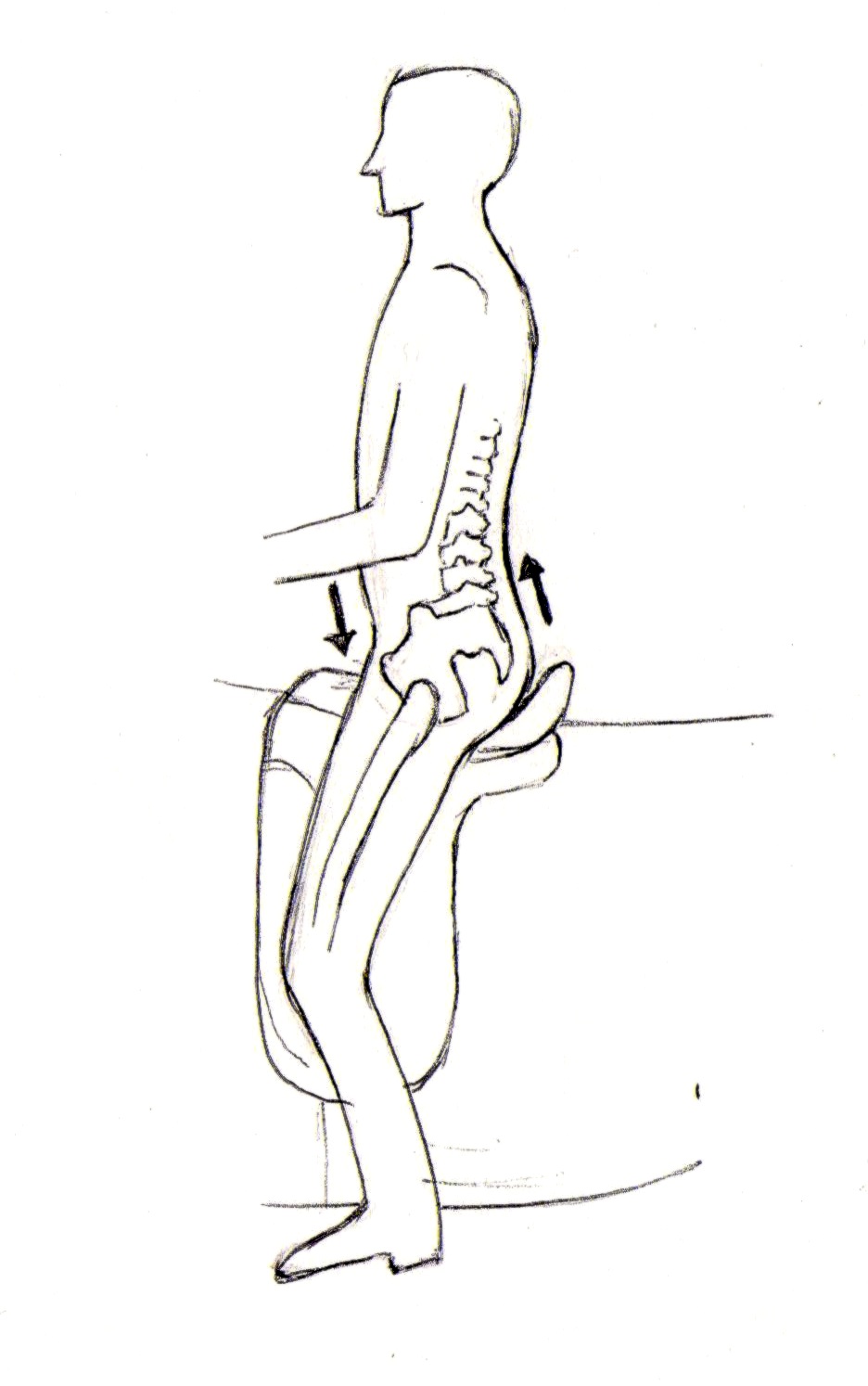
As already stated above, when the rider lets their pelvis drop onto the pubic bone, or ‘fork’(right) the seat is not only prevented from harmonizing with the horse’s movement, because it blocks against it, but it also has zero re-balancing power in this position.

This is because re-balancing a horse with the seat comes from the leverage we create by raising the front of the pelvis into suspension off the saddle by way of engaged core muscles. When the pelvis is passively dropped into the fork seat, it has no leverage with which to draw the horse’s hindlegs underneath its body, and instead it follows into the backwards thrust of the hindlegs, supporting the disengagement of the haunches, as opposed to their engagement.

The further the rider’s centre of gravity is from the horse’s, the less secure the the rider is, and the more the horse will also feel tense and anxious.

Some riding instructors actively teach this kind of seat, sometimes referred to as the three-point seat, because it is a convenient and effort-free way of finding  a certain stability while sitting on a horse. The backward-pointing seatbones also block the horse’s movement to some extent, making it easier to handle. However, as a way of truly becoming part of the horse’s movement, and being able to improve its power and purity, it is certainly no solution.

Raising the Centre of Gravity

When sitting on a horse, it’s common for the rider’s center of gravity to rise towards the upper body, lifting the weight up out of seat, and away from the horse’s own center of gravity.

This is often the result of tension in the rider, as when we do not feel balanced and in control on top of the horse, there is an instinctive desire to lift up away from the movement. The shoulders become tense, and the seat is less connected to the movements of the horse’s back.

This is a viscous circle, of course, because the further the rider’s centre of gravity is from the horse’s, the less secure the the rider is, and the more the horse will also feel tense and anxious.

Common faults in the riding position. Image by www.Happy-Horse-Training.com

Common faults in the riding position. © www.happy-horse-training.com

All of these errors in the technique of sitting on a horse result in a lack of unity between horse and rider, and make the rider feel they need to hold onto the horse’s mouth in order to control the situation, and keep some of balance. This holding is counter-productive, however, because it blocks the energy of the horse’s movement and creates tension in the horse, both of which prevent a true gymnastic connection of the rider with the horse.


The Key Steps to Sitting on a Horse Well

The Keys To Sitting On A Horse Well

The correct riding position. © www.happy-horse-training.com
1) Tucking the Pelvis
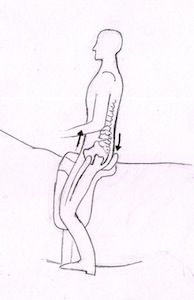
The number one most important thing you can do to start becoming part the horse’s movement is to get your pelvis in the right orientation in the saddle. This means rolling the seat under into a tucked position, so that your weight is on the back of your seat-bones, and the front of your pelvis is lifted well up off the saddle by your engaged abdominal muscles. Your lower back should be stretched and supple.

This position may feel unstable or unbalanced at first, because it takes strength in the core muscles to support it, which is something a rider needs to develop over time by consistently making the effort to sit in this way.

It is only in this position that the pelvis can follow the cycle of the horse’s stride without opposing it, and eventually create the leverage which brings about true collection and re-balancing of the horse.

Riding instructors often refer to the ‘upright seat’ as a kind of balance between the fork seat and the tucked seat (often mistakenly referred to as the chair seat). However this is simply a half-way house, which doesn’t go far enough towards resisting the disengagement of the horse’s haunches that happens naturally every stride. This upright seat, although less extreme, is therefore not much more effective than the fork seat.

2) Keeping the Upper Body Back

When you first start to ride with a tucked pelvis, because your core muscles will most likely not have the strength and coordination to support it, it is important to keep the upper body well back, in order to help keep the weight on the back of the seat-bones. This is especially important if you have a if you have a naturally hollow back.

In sitting trot, if you gradually lean back, you will feel at a certain point your seat adheres to movement right through the stride, and there is no bouncing on and off the saddle. This is the place where you need to stay in order to develop the correct seat.

As your core muscles get stronger, you will be able to come gradually more upright without losing the tuck of your pelvis.

3) Suppling the Hip Joints

The hips joints are probably the most crucial joints in the rider’s whole body, because they act like a hinge between the seat/upper body and the legs.

To create a balanced position on the horse – one that is independent of the reins – the rider must stretch this ‘hinge’ open to its fullest extent, so that the leg can remain anchored underneath the rider’s body, which equally stays back in position.

The problem, when it comes to sitting on a horse, is that our hips are very often not supple enough to allow this stretch to happen – our lifestyle is largely responsible for this, as we spend a lot of the time sitting with the hip joints in a closed position, as well as the immobility leading to stiffness.

Some of us have more stiffness in the hips joints than others, but all riders need to develop the stretch in this joint.

What happens when we ride without supple, stretched hips, is that when we try to bring our legs back into a balanced and effective position underneath the seat, the upper body is pulled forwards, leading to the problems of leaning forwards described above. In the same way, when a rider tries to bring the upper body back without being able stretch the hips, the leg is pulled forwards into the ‘chair seat’.

Tucking the pelvis, as described above, puts even more demand on the hip joint, and it therefore takes a long and determined effort for the rider to achieve both the correct seat and leg position. Although this is not commonly seen, it is not an impossibility, as is sometimes stated. Any rider can achieve supple hips if they know how to go about it, and put in the effort required.

Note: Yoga poses, suppling and stretching exercises help with this greatly. It’s not hard to find some videos on Youtube to get you started on loosening those hip flexors.  : )

4) Lowering the Center of Gravity

The rider must always be seeking to drop their centre of gravity towards that of the horse, so that a unification of the two body masses can be achieved. Only when the rider can become fully joined to the horse’s movement, can they start to transform it in a profound way in order to bring it into balance.

There is a misconception, fairly common in dressage teaching, that the rider should try to remain light in the saddle in order to help the horse lift its back without overburdening it. This is a misunderstanding because the horse is far more comfortable with a rider who has become fully part of the movement, than carrying one who is attempting to hover above it.

There is no way the rider can physically become lighter when sitting on a horse, but by harmonizing with the movement and creating one unified mass, the negative effect of the rider’s weight is removed.

To do this, the rider must drop their weight completely down into the back of the seat by keeping their neck, shoulders and lower back relaxed to prevent the center of gravity rising.

The fact that the front of the pelvis is suspended by the engaged core muscles, combined with the stretch of the hips keeping the legs supporting underneath the seat, means that the weight dropped into the seat is not a ‘dead weight’, but instead a kind of adhesive glue that keeps the dynamic, interactive seat fully connected with the horse.

5) Remaining Central

Both horses and humans all have a natural unevenness, which means that when sitting on a horse we almost always get pushed slightly more to one side or the other. In fact, it is usually the saddle that gets pushed over in relation to the horse’s spine, and we may sit more over to the other side of the saddle in order to compensate.

There are several factors which contribute to how this lack of centrality will manifest:

  • the crookedness of the horse: all horses have one side which is naturally convex, and the other which is concave (hollow). The rider tends to get pushed over to the concave side.
  • the crookedness of the rider: we all have one side of our body which is stronger for stretching down, and this opposite weak side tends to get pushed over more easily on the horse’s back.
  • the bend: when a horse turns, its ribcage tends to push the rider more to the outside.

Depending on how these different factors combine, the rider can end up  sitting on a horse markedly off-centre in relation to the horse’s spine, or less so because the various factors compensate for each other. Either way, it is essential that these unevenesses be addressed so that both horse and rider can become more straight, and gymnastic purity an be achieved.

The rider can become aware and monitor the centrality of their seat by frequently checking how well the pommel of the saddle lines up with the horse’s spine (withers) underneath it, and also by making sure they are sitting absolutely centrally in the saddle. This needs to be checked both from in front and behind, as there may be a twist in the seat, so you will need someone to tell you whether you are sitting straight on the saddle from the back.

Once the rider is familiar with the pattern of their own and the horse’s unevenness, postural strength must be used to diligently correct it as much as possible.

A final important point is that the rider must never add movement of their own to the horse’s movement when sitting on a horse, for example by pushing with the seat or moving from side to side. We can only connect to the horse’s movement when we have a ‘listening’ seat not a doing one. We can modify the movement we receive in the seat with postural resistance, because this does not add movement, it is instead a way of channeling and re-balancing the movement of the horse.
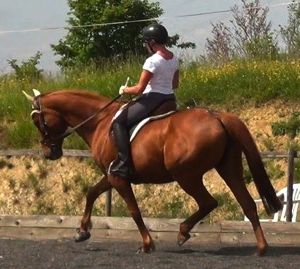
When a rider has mastered this way of sitting on a horse, they become fully independent of the reins for balance and security, and the control of the horse is almost fully achieved with the posture, seat, leg and weight aids – the hands taking on an almost fully receptive role.

Sitting on a horse in this way is also so much more comfortable and healthy for both horse and rider, because concussive forces are harmonized, channeled and transformed into straightness, power and suspension.
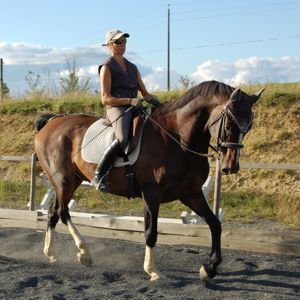
ABOUT

Happy Horse Training is founded by the sisters Camille and Gabrielle Dareau, who live in the beautiful Gascony region of the south of France. 

OUR PATH WITH HORSES

In our passion for the art of dressage as a pure gymnastic discipline, we have taken the perhaps unusual approach of studying riding purely for its own sake with no other agenda, whether competitive, commercial or even that of simple recognition.

This has allowed us to work with horses that in most other circumstances would be rejected, and in doing so we have discovered exactly how it is that the rider can transform themselves in order to transform the horse.

In the normal context of dressage based on the performance of certain movements, our results may be limited, but the quality of movement we achieve through progressively suppling problematic horses by means of engagement speaks for itself. Riders who apply the principles we teach, often very different from what they learned previously, are equally convinced by the results. When we come to difficulties with our horses in their training or management, we don’t think of ‘selling them on and getting another one’ as being a relevant option. To us that would only mean passing up an opportunity to learn something from the process of finding a real solution. thanks to this attitude we have seen many of our horses develop a radically different appearance and disposition, to the point of a real change in their conformation and basic temperament, characteristics usually seen as unalterable.

In the same way we have seen riders of many different types and abilities transform to become confident, effective and skillful at riding in engagement, which had often been a totally undiscovered dimension of riding to them.

Leave any comments you might have below, I’d love to hear what you think about this article.

See ya,

bonita

Saturday, May 31, 2014

Take It Easy


Like the famous Aussie anthem; “Take it ea-sy, take it eeeeeasy…” I have been doing exactly that with m’boy Copper.

Between the two of us, we sure have managed to rough ourselves up. *sigh* I severely twisted my ankle three weeks ago, and my physio banned me from riding for six weeks. Hah!

Copper’s been off work for more than four months and I have been dying. DYING I TELL YOU!

So I’m doing the *smart* thing and riding my not-ridden-in-forever horse bareback. I know, I know, but I just can’t help it.

Besides, we are only walking! Well, supposed to be walking anyways. I stuck to the plan for the first ride, we did a lot of lateral work. Interestingly enough, right after I hopped on he kept swinging his head around to nip at my toes. He was not happy! I knew he wouldn’t be, which was why my plan was to loosen his muscles up.

(I had lunged him first, but stopped after a few rounds, he wasn’t flexing well, he was counter-bent, and he just wasn’t softening up so I knew that continuing to lunge would be counter-productive.)

Actually, for the first fifteen minutes of our ride every time I stopped he would swing his head around and snap. I was glad that communicative, but negative behavior stopped half way through - my plan totally worked. He felt better!

Second ride, not so according to plan though… Copper was super happy to see me, he was hanging out at the paddock gate and nickering as I walked up to fetch him. He even stood like a rock for me to hop on; which is something we have to sporadically work because often his mind will leave before I’m fully mounted, and he’s walking off. But that’s by the by, because for all the sweet behavior, this time I was met with fire and brimstone pony!

He was tossing his head and snorting, and it makes me giggle so much. Copper wanted to run!

I would ask for a leg yield and he’d start trotting. So I was all, “Welp, you can do that, but you’ll have to work for it.” 

I sat back and lifted my hands to try to hold him to together so that he didn’t take off. Bareback trotting is hard at the best of times when you haven’t practiced in ages, let alone done any actual riding! Add a ex-trotter Standardbred jackhammer trot on top of that. Words can’t describe the ouchie.

I worked hard to try and actually lift my seat in time to his bounce to encourage him to work through his back. I didn’t always get it right, but we actually had a half-decent trot. I would have loved to see footage or photos to see if it looked half as good as it felt. It felt up hill and powerful, not soft or elastic, but that can hardly be expected given his complete and utter lack of muscle tone. Seriously, for a horse so fat, he looks like skin and bone! He’s an absolute pudding at the moment. : P

Best of all, I felt quite secure, even when he was trying to put his head down and buck while trotting. So there’s that.

And that’s it for the rambling, I really shouldn’t go over too much more boring detail.  (→ ▽ ←)

See ya,

bonita

Friday, May 2, 2014

Getting there


After much careful watching and prodding, I am hopefully declaring Copper to be abscess free. I hope.  I can’t tell for certain, and I think that’s partly why I am so stressed over this wound. 

Wither wounds are quite serious due the nature of their placement.  There is no easy way to tell externally (without x-rays or scans) whether there is any infection or crud pooling down below the surface.

So far we have had no temperatures, tenderness, lameness, redness/puffiness around the wound, or general “off-ness”. The wound flesh is pink and healthy looking, as well as closing over quite rapidly. I am 85% sure everything is healing as it should be, but there is 15% of me that seems to be convinced that something insidious is brewing under the surface where I can’t see it, or feel it. 

I don’t know why I am so paranoid about it? Usually I can just do the whole ‘wait and see’ thing quite well, but maybe it’s due to the sudden appearance of the wound without any particularly satisfactory reason that I know of.

Anyway, I’m still keeping a weather eye out for any further trouble… In the mean time, the pon-pon is enjoying the spoiling, so I guess that’s something! :P

See ya,

bonita

Thursday, April 24, 2014

Wither Abscess or Fistulous Withers?


Uh-oh, we’re in trouble. So that theoretical “kick”- definite blunt trauma of some variety - that Copper received on his withers about a week and a half ago has burst into a large open sore. It may be some sort of bacterial infection, a parasite, or possibly Fistulous Withers – a chronic inflammatory disease of the supraspinous bursa1 caused by either infection, parasites, or physical factors. Swelling of the withers, drainage of pus from an open lesion resulting from inflammation, and infection that spreads from the infected bursa to surrounding tissues are common characteristics of the disease. Actinomyces bovis and Brucella abortus are the most common organisms responsible for this disease.*

The stages of this injury went like so:

Sunday, 13th of April: Discovered Copper has localized swelling around the side and top of his withers. Extremely painful to the touch, little to no heat in it, and does not appear to effect soundness. Palpitation of shoulder, and flexion tests reveal no soreness anywhere else besides the swelling. 

IMG_6165[1]

IMG_6166[1]

Wednesday, 16th of April: Swelling appears to have gone down, but I think that Copper’s rug is not helping with the healing so I remove it.

Saturday, 19th of April: There are two strange, yelllow-ish crusty patches on his wither. One on the top and one on the left side – off the side to the base of his wither and above his shoulder. The top one is about the width of my pointer finger and around an inch – inch and a half long. The other patch on the right side is smaller, about half the size.

IMG_6169[1]

IMG_6170[1]

IMG_6171[1]

I think that these are odd – they look like some sort of infection. The hair is not disturbed, or scraped off, like bite marks usually look. It looks more to me like the event has occurred underneath the skin and some sort of infection has broken through the skin and crusted up.

I decide that if it is an infection – perhaps it is an abscess due to the blunt trauma, something needs to draw it out. So I apply some poultice – good old Tuff Rock.

Thursday, 24th of April: I come out to find this -

IMG_6143[1]

IMG_6146[1]

IMG_6147[1]

IMG_6151[1]

I immediately call the vet, something strange is going on.

His withers are now swollen on both sides, but there still isn’t much heat in the area - although Copper is still extremely sensitive to any pressure. The vet gives him a mild sedative so that we can take a good look. After washing and inspecting the wounds, the vet suspects either a parasite or bacterial infection – but there is no mention of Fistulous Withers.  Copper is given a jab of antibiotics for systemic treatment and the vet advises me to wash the wound down daily with Betadine and the apply Savlon - which is topical anti-bacterial cream used for humans, but it works great for horses as well.

Friday, 25th of April: So that brings us to today. All the regional swelling seems to have subsided, and Copper is a bit less sensitive around the wound areas. The Salvon has scabbed over, and I didn’t wash it all off, but plan to do that tomorrow to check out the flesh underneath.

One of the girls down at the paddocks today mentioned Fistulous Withers, and of course, I wondered if that was going to be a problem. I jumped on the internet and did some research. Originally, Fistulous Withers is a very nasty condition that used be quite difficult to eradicate back in time, and quite often would render the infected horse useless or dead!

After further study, I don’t think we have to worry about the infectious Fistulous Wither condition – yet.

Causes of the disease may be the result of infectious, parasitic, or physical factors. Actinomyces bovis and Brucella abortus are the common organisms responsible for fistulous withers, blunt trauma to the withers caused by tack or sharp contact with a fence or another horse or object can lead to infection and inflammation resulting in fistulous withers. The hair-like parasite Onchocerca cervicalis has also been implicated in the early stages of the disease.*

As we know that Copper was subjected to some kind of blunt trauma, and so far hasn’t shown any symptoms of an actual bursa infection which are:

  • Swollen withers – this has dissipated
  • Signs of fever and pain – some localized sensitivity, but no other pain symptoms
  • Open drainage fistulas – these are described as long, narrow tubes2, which his wounds are not.
  • Lameness – no signs
  • Systemic illness – no signs
  • Swelling at other areas – no signs

I am assuming that he has not yet been deeply infected in that region. However, in saying that, he obviously has had some kind of abscess in the region of his withers, and whether or not that has fully drained when it burst, or is still causing problems which may lead to a full-on case of Fistulous Withers still remains to be seen.

Unfortunately, my vet did not mention this AT ALL so I have no idea if Fistulous Withers is even on the radar, and it’s public holiday, so I can’t contact them to find out. :/ Plus, tomorrow is Saturday and I don’t know if I’ll be able to get a hold of her then either.

She did take a slid of the infection so I will ask her to test it for any nasty bugs when I contact them.

I will also wash the wound out thoroughly and keep a very close eye on it. The antibiotic jab the vet gave Copper was good for four days, so hopefully that will keep things under control internally and stem any infection until I can get a hold of her again.

So stressful, but I think we have the situation under control for now…

See ya,

bonita

1 The Bursa: A closed fluid-filled sac or sac-like cavity. The bursa provides a sliding surface between tissues of the body. Poll Evil and Fistulous Withers are two inflammatory conditions that are closely related and differ essentially only in their location in the respective supraspinous (withers) or supra-atlantal (poll) bursae.
The Merck Veterinary Manual

2 Fistulas are narrow mouthed ulcers or abscesses that can can run a long way under the skin like pipes.
Fistulous Withers

*Information from EquiMed.com

Wednesday, April 16, 2014

Broken Ponies


And so our dismal run of bad luck and broken ponies continues…

I came out on Sunday to trim Copper’s feet, only to find out that he had a swollen, misshapen whither and swelling around and above his right shoulder blade that was extremely tender and sensitive to the touch. 


IMG_6043[1]


IMG_6045[1]


IMG_6044[1]

He didn’t seem off when I did some flexion tests of his shoulder, and I couldn’t find that much heat in it, but I haven’t seen him that swollen in a while. So I freaked out. Juuuusssst a little…

Okay, so the last time I’d see a horse do a lot of damage to it’s whither/shoulder was a psycho TB mare called Clippy. 

Clippy had reared while she was tied up, and at the height of her rear, started to topple over backwards – still tied up! The baling twine she was tied to broke under pressure of course, but that only added to the force with which she hit the ground. She landed flat on her back, and got up just fine.

However, she had shattered her whither to the point where it had literally disappeared – only bone fragments were left floating around down between her shoulders. Clippy then had to be confined to a small yard (just larger than a stable) for six months, drugged for that same amount of time with painkillers and sedatives so that she didn’t move around too much. It was going to take her another year to heal properly and then, well, she’d never be rideable again. Not that she was particularly rideable to begin with(!!) but that’s a whole other story.

Yes, I prodded Copper’s wither and was relieved to feel that there was still solid bone and nothing felt like it was wobbling around or where it shouldn’t be. I wasn’t so much worried that he’d pulled a muscle as there wasn’t much heat, as that he’d somehow managed to fracture his wither.

I wanted to call a vet, but my Dad (who was giving me a lesson on hoof trimming) convinced me to at least wait a day or so to see if the swelling went down at all, given that he seemed to have a fairly full range of movement with a flexion test and was only about grade 2 lame.

Then, when I checked him out on Tuesday, I spoke with one of the ladies who adgists in the same paddocks (I’ll call her L.), and is very experienced. L. thought that given the shape, position, feel and look of the swelling, combined with the fact that Copper was not at all uncomfortable in the muscles underneath his shoulder blade (she showed me how to palpitate underneath the shoulder blade for tenderness) that it was a “wait and see injury”.

We came to the conclusion that it was some kind of bone bruising, and that quite likely the boys had been derping around in the paddock and someone struck Copper on top of his wither with a fore hoof.

:/   Huzzah.

So the grand sum of all these injuries over the last few months have happened in the paddock with Copper being an eejiot.   Double huzzah.

I left his jute rug off (I only rug in winter to save time and keep the pon-pon clean) because I felt like that was going to add pressure to the swelling and have decided to give him ANOTHER week off for the swelling to subside before starting him back in work with some ground work.

Which will make it probably over three months now until I get to ride properly again. Ugh. Horses…..

I’m so tempted to buy another one just so I can ride again! I’m going mental I tell you, mental!  But ten to one, that one would break too, so really…. There’s not much point.  :S

See ya,

bonita

Wednesday, April 9, 2014

Slow rehab waiting


It’s one of those days when you realise it’s been well over a month since the last blog update!

*sigh* I’m still waiting on Copper to be fully sound again. ‘Coz if bad luck comes in threes – than we’ve had it!

End of January: Copper comes in lame with a puffy tendon on his off fore.

Beginning of February:  Copper has been kicked above his knee resulting in puffiness and swelling on – you guessed it – his off fore. Same leg, two injuries. D’oh!

End of March: Copper is almost sound in his leg, but wrenches his back/croup running around in slippery mud and is extremely sore.

So here we are, well into April and I can’t believe it – my horse has been off work and lame for over two months! (O_o)

I have to say this is fairly unexpected, usually it doesn’t take so long for him to be sound again, but oh well. I’ve been feeding him, grooming, poulticing and the like, and I think he’s enjoyed the extra attention? I don’t really know – he’s not so much of a horse that you fuss over.

He’d rather be in the paddock eating grass with his pony pals rather than getting fussed over. Which I guess is fair enough. ; )

Hopefully we will soon see an end to this rather extended break, I’m itching to get back into the saddle for some real riding!

See ya,

bonita

Sunday, February 16, 2014

Training Tip: A Dressage Hack–Hill work


A different kind of horse on a hill - A Riding Habit

The other day I was out and about doing some warm up with Copper and I was delighted to find the most powerful, spring-y, suspended walk strides that I have ever felt from him. I mean, that boy was really sitting on his haunches and engaging his hind engine – he was so collected and elevated!

Thus, my secret hack for a sport we all know has no short cuts… Hill work.

How to do it:

I was warming up Copper, so I focused on allowing him to swing freely over his back. To do this, I sat in two-point and gave him his head so he could walk freely up the hill. At the top, I turned him around and sat as lightly as possible through my seat as he went downhill.

I did that until he felt sufficiently free-striding, then shortened my reins to take up contact. On the way back down, I rolled my hips with the swing of his barrel (sometimes this is described as a figure of eight motion, sometimes a ‘C’ shape, sometimes a side-to-side movement. I like to think of it like bicycling my hips in time to his swing.) and sat down into his movement.

At the same time, I kept my hands steady, and light, with an elastic, supple connection through my elbows. I literally was thinking “Lift up, lift up” asking him to lift through his shoulders. He responded by doing that and really sitting on his haunches. Man, it felt so good!

I was like *gasp!* “We can dressage!” and Copper was all *gasp!* “HARD!” and lost it… Haha. 

Still, it was one of those lovely moments when you know that you are doing something right because you felt that next level dancing tantalizingly just out of reach. I love it, because it gives me something to aim for. I know the movement and ability is there, I just have to unlock it.

I called this post ‘hack’ though for good reason, because honestly, I think it easily could have been months, maybe years before I felt that kind of movement from him in an arena. Having the benefit of the hill to encourage Copper to sit deeply and engage his hindquarter engine is invaluable.

Though we know there really aren’t any hacks to true collection, I think we both benefited from feeling that true elevation. Hill work is a great tool to have in the dressage training toolbox as it’s a long path, but so worth it.

See ya,

bonita

Post share buttons