Showing posts with label listening. Show all posts

Tuesday, June 28, 2016

Dissecting the Seat – Part 4: Biomechanics of “Bearing Down” and plugging your seat in with the horse’s movement

Expanding from this post, a more in-depth explanation about the biomechanics of the seat and how it affects the horse’s energy an “thoroughness” in an excerpt from Mary Wanless's Article 42.

april_1

…When a rider is having this problem, I like to say "Imagine that we could perform a surgical operation, and insert a fishing rod just beneath the horse’s mane. If it had a small fish on the end of it, it would make a slight curve throughout its length. The whole length of his neck should ideally feel as if it really were hung from a fishing rod. But you may find that the rod has soggy bits, or even that it’s missing completely. What do you sense is happening here?".

People can normally answer this question very easily, and you can probably imagine from looking at the photo that the fishing rod ends two thirds of the way up the horse’s neck. What is much less obvious is that the fishing rod will also be soggy at the base of the horse’s neck. This is the part which the rider must repair first - and amazingly, just thinking like this is often enough to fix the problem! Having reorganized the base of the neck the rider can then successfully think about the top of it …

Horses find it very difficult to make the correct connection from the hind leg, over the croup, under the panels of the saddle, and up the crest of the neck. Think of this as an energy connection, or as water flowing through a hose. When complete the circuit continues through the rein to the rider’s arm and back, so that the energy received into her body rejoins the original conduit. This connection gives the rider a very correct influence, and enables the horse to seek a light contact with the rider’s hand, and, potentially, to "sit himself down". How wonderful horses look when they achieve this! But it requires very skilful, correct riding, and the lengthening of the horse’s spine mirrors the "use" which people aspire to when they have lessons in the Alexander Technique.

This horse breaks the circuit both at the base and at the top of the neck. He also is not "sitting himself down" – if anything I think he is raising his croup to evade this demand. Instead of maintaining the correct connection whilst shortening his whole frame as he would in collection, he has scrunched his neck backwards whilst lifting his croup. So things have gone rather awry - and as always, the rider is unknowingly playing a part in allowing this to happen.

She too has lost the ideal connection in her own spine, this time by stretching it too much and in the wrong way. From her waist she has separated both halves of her body, drawing her ribs up and stretching her legs down. If we could see the shape of her back, I am sure we would find that it is hollow. However, we all hear so much about "growing up tall and stretching your legs down" that our rider will almost certainly believe that she is sitting correctly! But I like to think of riding as a martial art, and this is not the stance used by good martial artists, who understand that this kind of stretching renders you much less stable and effective.

If you stand in a martial arts position and then exaggeratedly grow tall and lift your chest, you will find yourself all but holding your breath. You will also feel very tense and unstable. Then drop your ribs down towards your hips, so that you remove the hollow from your back. (Doing this sideways on to a long mirror will give you the clearest feedback.) For added strength, you can then engage your abdominal muscles in the way I call "bearing down". Cough, giggle, or clear your throat, and then maintain that muscle use. Your major difficulty might then become breathing, for to bear down continuously you must use diaphragmatic breathing, which only seems to come easily to people who run, sing, or who have learnt to play a wind instrument.

Many people who "grow up tall" are shocked by my insistence that they need to drop their rib cage. By comparison, they often feel slouched or round shouldered – so they are convinced that this new idea must be wrong. Some have heard the idea from the Alexander Technique that they should think of themselves "being pulled up by a string attached to the top of the head". These words, however, are intended to describe a much more subtle expansiveness through the whole back and neck, which is not the same as this hollow backed version of growing tall.

The version of "stretching your leg down" which accompanies the wrong way of "growing up tall" becomes an attempt to get your knee beneath your hip to and make your whole leg vertical. This usually generates a strong pressure into the stirrup, which pushes the heel down and forward. If you are sitting in a chair as you read this, push one foot hard down into the floor, and realise how doing so tends to lift that side of your pelvis. Your body is obeying Newton’s third law of motion, which states that "every action has an equal and opposite reaction" ie. every push down will create an equal and opposite push up. This is one of the main reasons why people usually sit to the trot better without their stirrups – for they cannot then push down on them, and do not experience the straightening of their joints which then sends their backside up out of the saddle.

This bodily use opens the angle between the leg and the body too much, and it plays into the horse’s evasive pattern. (It would take me too long to explain to you exactly how this happens.) So to change her horse, this rider needs to change herself, completing her part of the circuit before she can complete his. I would like to see her bring her lower leg back underneath her and lighten her pressure into the stirrup. Creating a vertical shoulder/hip/heel line will make her feel as if her heel is back and up, and the change will probably horrify her! She also needs to spread the weight which does go into the stirrup over the entire width of her foot, and not roll her ankles over to weight the outside of the foot. The next step is to think of the thigh and calf making an arrowhead shape, in which the knee is the point of the arrow. This means that she will no longer be "stretching her leg down" in the way she is now.

Simultaneously, she needs to drop her ribs down towards her hips, and to take the hollow out of her back. This too may horrify her. It is as if she needs to shrink both ends of her body towards the middle – and into a martial arts stance. Then she is in a position for make the "fishing rod" idea work for her.

How to feel the “bearing down”: excerpt from Article 37

With your seat bones pointing down and your feet flat on the floor, put one hand under your sternum, and put the thumb and first finger of the other hand each side of your spine at waistband level. Then clear your throat. You should feel your muscles push out against your hands. Put your hands on your sides and repeat the experiment. Then place the fingers of one hand half way between your belly button and your pubic bone, and clear your throat again.

Sam is riding as if she is doing this permanently. I first called this use of your abdominal muscles ‘bearing down’, although I now think that ‘bear out’ might have been a better term, since it does not make you sit heavier. Wherever you have soft tissue, i.e. in the entire band around your waist between your ribs and your hips, and all down your abdominal muscles from your sternum to your pubic bone, your guts push against your skin. Think of pulling your stomach in, making the muscles into a wall, and then pushing against that wall. It is as if your torso were a jam jar or a baked bean tin, and the contents of the tin are under pressure, pushing against the edges, but without deforming the shape of the container.

The next difficulty arises with the need to breathe and bear down both at the same time. This requires diaphragmatic breathing, which will be familiar to you if you have learnt to sing or play a wind instrument. In this, the ribs expand outwards but do not lift up: think of the air being drawn down into your abdomen, as if pair of bellows down there was sucking the air in.

Bearing down whilst breathing well is a big deal for most riders – I suggest that people practice whilst driving their car, for this has to become a way of life…

….

I’m delving more into the biomechanics of riding, because I believe that a lot of what I am reading here I have either experienced in person while playing around with my seat connection on Copper, or it is something that I need to experience because it’s a missing connection.

The subtle feedback of a horse’s energy into your body as you position your skeleton in different ways – releasing some muscles, holding others – is a endless book to learn from. But I am trying to read this book all by myself and if there is insight to be found, I am more than happy to learn elsewhere!

More pieces of the puzzle are falling into place.

One thing I do know more and more for certain from this journey I’ve been on: THE RIDERS WHOLE BODY INFLUENCES THE HORSES WHOLE BODY

… How I breathe, how I tilt my head, hold my neck, bend or straighten my wrist, shift my left seat bone, etc… It’s a matter of learning where to place each individual part of me so that it is most effective in influencing Copper’s energy and movement. 

The riding masters know that, I wish that more teachers would teach that instead of focusing so much on the horse. Get the rider right and 90% of the work is already done.…

See ya,

bonita

Wednesday, December 9, 2015

Moving Shenanigans & Settling In

Shenanigans > (greater than) Settling into new paddocks. That about says it all doesn’t it?
Sunday morning, out in the paddock…

IMG_6481
- “Rawh! My treatz!” says Copper to Robbie, his best bud -

IMG_6480
- “Oh-tay, we iz fwends agin… Wut you mean – Buh Beye? I dunna get it…” -

IMG_6482
- “Oh, dis wut you mean… One of dese homen-beanz horse gobbling fingz.” -

IMG_6483
- “Srsly – agin with de clicky fing? No… Won’t smile… Wanna eat.” -

IMG_6484
- “Weh you goin’? …Mom! …Mom!! DON”T LEAVE ME!!! I DON’T NOE ANYONEZ HERH!!” -

IMG_6485
- “Told ya not to go…. *insert smirk*” -

IMG_6486
- “I didn’t noes fencez bit! Honest!” -

IMG_6487
- “Hai… I iz glad you here…” -

IMG_6488
- *omnomnomnom* -

So long story - everything was going really smoothly with our move...  Turns out, it didn’t quite stay that way!!  :O

We started by picking up the hire float, then fetching Copper in from the paddock.

I prepped him for travel with float boots and plaiting up his tail. Copper walked up the ramp, stopped – had a sniff and a look, then marched right on.

I was so relieved… I didn’t expect any trouble, I know he’s been well trained with floats being an ex-racer off the track, but counting it up – Copper hasn’t been out on a float in over four years!  So I was kind of wondering if he’d be easy or a bit tricky.

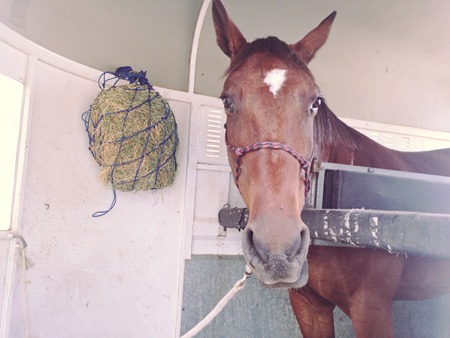
We got over to our new home in 45 minutes or so – and he travelled really well, no clopping or clattering around – just eating from his hay net.  I should take him out more often…  :P

He unloaded fine, we walked around and explored; said hello to new pony faces over the fences, and then walked every inch of his new boundary fences.  *phew!* That took a while – and less than half way through he was all: “Can we stahp? Bored now… I want munchies!”

Copper was looking fairly settled - still a bit stressed and anxious, but he wasn't pacing or anything. He was eating, drinking, pooping and peeing - very normal horse behaviour, so I went home to fetch a hose and come back to fill up his trough.


In the hour or so that I was gone the dingbat ran through a border fence between paddocks and ended up in the neighbour's paddock!!


He was okay, but had to be rescued by the neighbour. He ended up with some abrasions on the front of his hind cannons - right on the front/under his hocks.

There was also a minor cut that was a bit deep, it had a skin flap that I gently pulled back and flushed with a ton of betadine!

I bandaged the cut, I was hoping that would hold the skin flap on so it would reattach, but the bandage slipped down in the night and the skin flap was half attached, and half dried up when I came back out the next morning.  

I fully expected to see swelling and lameness, but he was actually pretty good. So I guess it’s all’s well that ends well – for that kind of incident it could have been a lot worse.

If it teaches him to respect the fence though, I guess that's good, because seriously horse!

Loser

Such a silly boy...

But he is all "Don't leave me!!" when I go down, so I do feel sorry for him.

Don't Leave

He's uncharacteristically clingy...

He is fretting a bit, and won't go into the actual paddock to eat. He's just staying the lane way down the front which isn’t very large, and doesn’t have much grass at all.

I mean, it's not like he couldn't stand to lose a few (Let’s be real here - a lot!) kilos, but I don't want him to colic.

I have been visiting him twice a day – once in the morning, and once in the evening for the last three days; Monday, Tuesday and Wednesday.

On Wednesday morning, this happened:

IMG_6489

Yep, first ride in new place… 

There’s not much to say about it, except he was a lot more rideable than what I’d been expecting!

With a little lunge (when he was trotting he exhaled the giant breath he’d been holding… Lol) and some lateral work at a walk, he was listening and felt quite relaxed when I hopped off 20 minutes later!

I was stoked – I feel like the work we’ve be doing towards learning how to relax even in tense moments has really been sinking in! He had all his marbles, but he was nice and forward – I was thinking that this would be a great competition frame of mind. ;)

It’s all groovy baby. 

See ya,
bonita

Monday, June 4, 2012

Getting the job done


So last Friday I had a lesson on Joey which turned out to be… interesting, to say the least!  He was very fresh (totally my fault), very spooky (totally his fault) and generally an all-around silly boy.

It started as I was longing him before the lesson, a couple mopeds came up the driveway, and he had a good whirl’n’spin to goggle at them in giraffe mode.  I knew it was going to be an iffy ride when he stood like a rock for five minutes staring after them even after they had long disappeared!  He wouldn’t even twitch an ear in my direction, so my first order of business was to ask for his attention when I hopped on his back.

I soon found out that that wasn’t going to be easy so my instructor got us trotting on and I do mean trotting!  I was asking him for forward – the shapes of the exercises we were doing weren’t important at this stage.  What we were looking for was forward movement from Joey, which would calm him down and get rid of the fizziness. 

I think we were trotting for a least 20-30 minutes straight, we did an hour glass figure (20m circles at A and C; changing diagonals across the arena), we did the 3 20m circle loop up and down the arena – basically we went around and around until I was dizzy and my legs were about to fall off!

It took quite some time before he started listening – we had arguments about which direction we were going to go in, and whether or not our circles where going to be 20ms rather than 18 or 15ms, and where or not we go past the “scary” side of the arena (which is TOTALLY not scary at all, it’s just the corner closest to all his paddock mates as well as being the corner he can see them from – ie, he was just being a moron.); these disagreements where met with one-rein stops, growling, and some rib thumping on my part.

No.  It was not pretty.  In fact, I felt like a right idiot snapping “Trot!! Get on!!!” rather loudly while thumping his sides repeatedly, but the fact of the matter is it got the job done.   No, I do not advocate that manner of riding if you do it without asking nicely first, but I follow Mugwump’s principles:

1. I ask with a whisper (actually, it's a touch, I'm not much on whispering). Once.
2. I say what's required with a firm explanation (using legs and hands). Once.
3. I make it happen. No matter what it takes, I make it happen.
  
Then I take a breath and go back to step one.

She developed this whisper, ask, TELL method from her own years of training experience and what she’s learned from other trainers, like Ray Hunt.

If anybody ever went to a Ray Hunt clinic they probably saw what would happen to one of his well broke horses if they quit listening. Ray got their attention, fast and hard. Whip, spur, bit, whatever it took to clarify his position, he was using it. His misbehaving horse would go scurrying back to soft obedience as fast as it could. Because Ray made the wrong thing very, very difficult if his horse knew better.

I think that the crucial principal is this:

Horses don't become soft if they don't understand there's a consequence for not being that way.  They need to understand the gentle touch of the rein or leg will be followed with a much firmer reminder of what's needed.

So even though I know my riding Joey in such a git-after-him manner wasn’t the best equitation, it was what he needed at that point in time.  Because when we stopped trotting, I took a deep breath, relaxed and softened my aids back to a whisper, and then he produced some soft, obedient walk work practising our 10m circles up and down the centre line.  By the end of the ride, he was listening to me. 

Like my trainer said; I had his number.  And if thumping his sides and growling at him was what it took, then so be it!

See ya,

bonita

P.S.  ~ All of Mugwump’s wise words sourced from here.

Monday, February 20, 2012

Whoo hoo!


woman_riding_horse
~  Not Sparrow and I yet, but someday…  ~

I am about as jazzed as I ever could be.  Today for the first time ever, with Sparrow,  I had my horse fully with me! 

It all started with the same routine – except that I had not ridden him in the last two weeks. 

Oh, this is going to be interesting. 

I went to get him and he was hanging out at the gate for me{isn’t he so cute?}, we groom and get ready to ride – uhoh, it that a saddle?  *Sparrow pulls face*

He looks grumpy as I tack him up, but I am prepared to lounge it out of him; no way am I just hopping on after the nice long holiday he’s had! 

He works really well on the left rein on the lounge line, but when we switch directions he doesn’t want to stay out on the track and keeps cutting in.  I use the whip at his shoulder to stop that, and he takes off at a canter.  He then proceeded to buck a bit which got him into trouble!   I don’t let him do that, and he knows it, so I growled and pushed him forwards; making him work hard for that bit of bad behaviour….

Now for the scary part.  Yup, it was time to mount up.  At this point I am moving slowly and methodically, forcing myself to concentrate on being calm and just breathing.  I have noticed that when I get nervous I tend to rush or ‘flutter’ about; so if I concentrate on each motion as accomplishing a certain task, that helps to calm the stampeding hamsters in my tummy!

I get on, thanking my lucky stars that he stands like a rock for mounting, which is always nice if you are feeling a bit squiffy about riding.  I settle into the saddle, marshalling my thoughts.  I have a plan today – I want to try out some new training techniques that I have been reading about.  So here am I thinking out loud as I absently scratch Sparrow’s whithers, as much to calm myself as the horse!

“Ok.  Think forward.    Get off his face.   Remember the 1-2-3 aid; seat bones, leg, then bucko-you-so-don’t-want-to-go-there with a touch of spur.   Control his feet with your legs.  Bump one side then the other if he’s sticky.  Keep your shoulders level.  Stay out of his face….”

I take a deep breath, asked for forwards with my seat, then had apply a touch of leg as he obviously hasn’t figured out a seat aid yet! 

And then we just walked around the arena.

Big deal?  Oh yes, it is!

It’s the first time since I bought Sparrow home that I’ve been able to get him just walk around the outside track of the arena.  Yes, he didn’t like the boggy muddy corner.  Yes, he was looky.  But he was looky at a loose, head-down, relaxed-ish walk.  When he felt like he was going to come off the track I nudged him ever so slightly with my inside calf, then the outside, alternating until he straightened up and relaxed. 

By the time I had gone around the arena twice on the left rein, changed rein and made my way down the long side on the right rein, I was grinning so hard my cheeks were hurting…

I had him.  He was there, in my hands, in front of my leg – listening…  I felt the tears well up.  I have spent the last two months stressing.  I didn’t know how to break through to him.  I didn’t know if I would ever get past his resistance without some serious fighting with each other.

Before today, even when he was obedient, it was like he was literally obeying because it was easier to do that then to make a fuss.  But the problem with that is that I could still feel the resistance. That slight stiffening in his back.  The tiny drag of his hind quarters.  And the hard neck.  My goodness, that neck!  I knew I didn’t have him, and I wasn’t sure what to do about it.

But today?  Nothing but softness…  We trotted in 20m circles.  We spiralled and leg yielded, and did even better spirals after that.  Sure,  he was crooked at times, and I would check my shoulders to make sure that the crookedness wasn’t my fault.  He would also loose focus once in a while, and I’d have to remind him that I was there, but you know what?

He always came back to me.  And that is just great.  I even decided to walk him out on the first little part of our trail ride, despite the fact that he’s been so spooky and boogy when riding without a trail buddy.  I felt confident doing so because I had a plan and I knew what to do!

I made sure he was pointing forwards while maintaining a loose rein, and kept him moving by nudging one side then the other when I felt him getting ‘sticky’ and worried about leaving his buddies.  We walked to the end of the jump paddock with minimal fuss, I halted him, and we just sat there for a few minutes then I dismounted.

I loosened off his girth and bridle and gave him the signal to graze.  He had a few mouthfuls of clover and then we walked back up the paddock together.  It was so funny!  You could see him thinking about the ride as we walked back.  When he’s doing that he kind of knots his brow and chews a bit, looking very thoughtful. 

I lead him back while he was ruminating, and pulled off his saddle.  He stood so quietly while I unbridled him and put on his halter.  Then he looked at me.  I looked back and…  I don’t know.  We just had a moment together, acknowledging the connection we found today.  I kissed him on the forehead and hopped over the fence to get his feed.  He dropped his head to graze – the moment was over. 

I am still euphoric.  What a day – what a ride!! 

And for those of you that are interested in the new riding/training techniques I’ve picked up – go read the Mugwump Chronicles if you haven’t already.  And I mean start from the beginning and read all of her posts type read.  Seriously.  Do. It. 

I learnt the nudge-nudge trick from her{although she calls it “bumping” – I just translated that to mean an English riding nudge.  Dunno if I am right, but it works!}, how to get your scaredy cat/barn sour/herd bound horse out on a trail ride by himself, why thinking forwards is so important, the principle of feet {control the feet and you have control over the horse},  and stuff that I haven’t even had time to process yet, but I know is lurking in the dark recesses of my brain… 

Best three days I ever spent.  And I proved that today by riding Sparrow and finding my horse.  I am so stoked.

See ya!

bonita

Post share buttons